
Category: Category name
Why Multi-Lender Platforms Are the Future of Home Improvement Financing

Explore financing options for home improvement contractors. Find the best solution for boosting revenue and streamlining operations.
Let’s Connect at MAG Payments Conference 2025, Booth 310

If you’re attending the conference and want to reform your point-of-sale financing, stop by booth 310 to discuss how our embedded lending platform can help you streamline your POS financing and boost approvals.
The Best Home Improvement Financing Providers, 2025

Searching for top prime home improvement financing partners in 2025? Compare lenders and see why ChargeAfter is the go-to multi-lender platform for contractors.
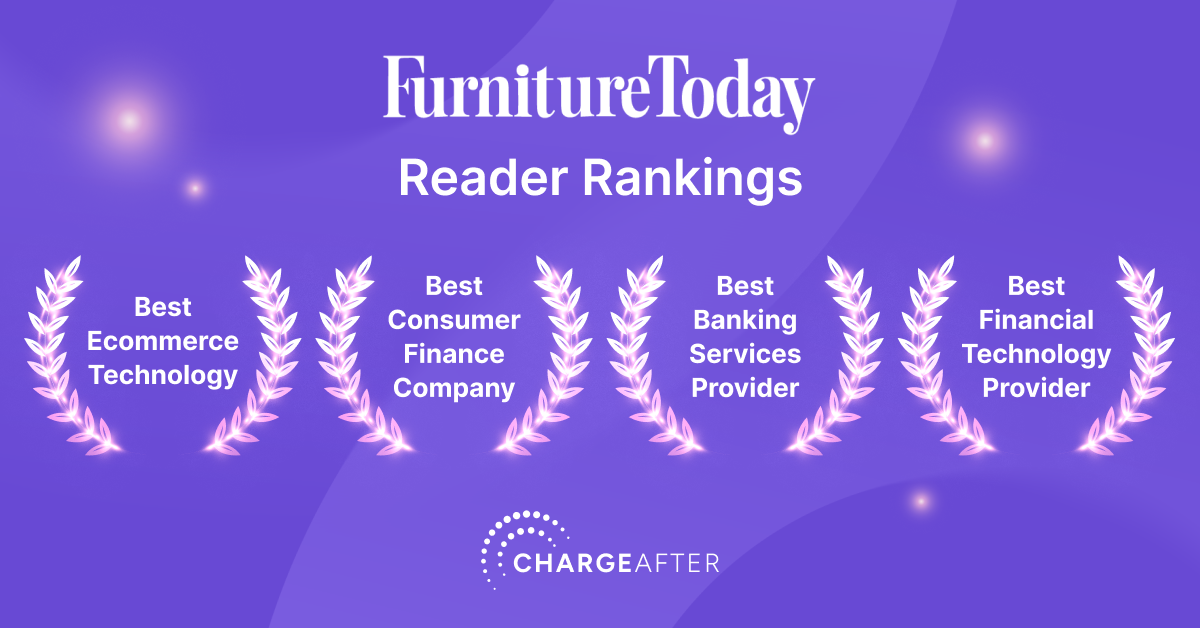
ChargeAfter Nominated for Furniture Today Reader Ranking Awards – Vote Now!

We are thrilled to announce that ChargeAfter has been nominated for 4 prestigious Furniture Today Reader Ranking Awards. The nominations reflect the success of our embedded lending platform in delivering financing personalization and choice to merchants’ points of sale, thanks to our phenomenal team’s hard work and dedication.
How to vote ChargeAfter
If you want to see ChargeAfter recognized for its industry-leading platform, we would appreciate it if you would take a moment to vote. It only takes a couple of minutes. Here’s what you need to do:
- Visit Furniture Today Reader Rankings
- Head to the “Technology” category:
Vote ChargeAfter for Best Software Provider (3rd award down, 3rd row) - Continue to the “Finance” category:
Vote ChargeAfter for Best Banking Services Provider
Vote ChargeAfter for Best Consumer Finance Company
You can vote every day until October 4th!
Thank you for being part of our journey. Let’s bring home these wins together!
Join Us at MAG Payments: Booth 214 & Panel Talk
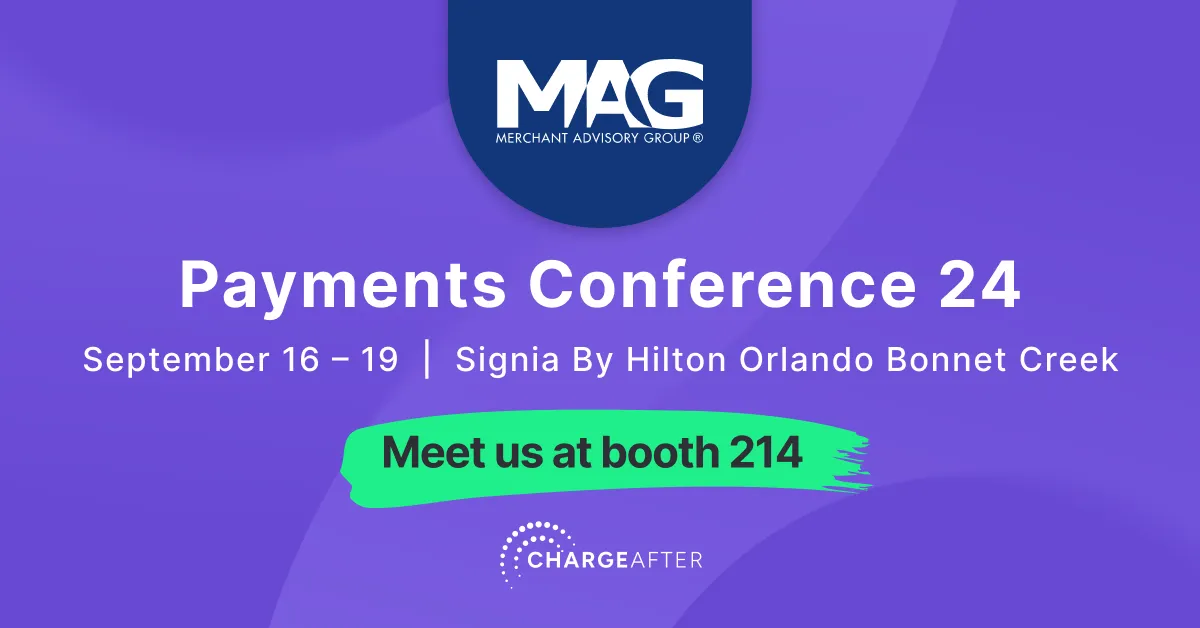
Join us at the MAG Payments Conference, September 16-19, 2024, at the Signia by Hilton Orlando Bonnett Creek in Orlando, FL.

Are you among the 78% of merchants prioritizing POS financing in the next 12-18 months*? If so, let’s connect! Our team is heading to MAG Payments and is available to discuss your POS financing challenges and see how our multi-lender waterfall platform can help you maximize your point-of-sale financing potential. Visit us at booth 214 or schedule a meeting with us. Swing by and you have a chance of winning a cool prize!
Panel Discussion
We are excited to invite you to attend our panel discussion Check your Balances: How Financial Inclusion is Defining a Generation with some of the biggest names in the industry.
- Meidad Sharon – CEO & Founder, ChargeAfter
- Jai Holtz – Vice President, Financial Services, Best Buy
- Jay Waters, Senior Director Financial Services, Lowe’s Company Inc.
- Nate Roe, Chief Commercial Officer, Progressive Leasing
- Moderator: Josh Pynn – Senior Manager, Payments Content, Merchant Advisory Group
Wednesday, September 18, 2024
3:05 PM – 3:55 PM
We look forward to connecting at the MAG Payments Conference.
ChargeAfter Survey Reveals Significant Decline in POS Financing Approval Rates

Only 2% of merchants achieve approval rates above 80%, a sharp decline from 12% last year.
Point-of-sale (POS) financing has become a crucial resource for shoppers to purchase the goods they want without relying on credit cards and for retailers to enhance customer satisfaction and drive sales. We conducted our second annual survey to understand how merchants are meeting their customers’ financing needs and the challenges they face. The results shed light on the current state of POS financing, revealing an over 50% increase in merchants reporting below 60% approval rates.
Key Findings
Among the key findings, the survey discovered that an average of 40% of annual gross merchant value (GMV) is attributed to financing. Despite the crucial role of consumer financing in sales revenue, most merchants are struggling with approval rates, which have sharply declined compared to last year. In 2024, only 2% of merchants are achieving approval rates above 80%, a sharp decline from last year’s 12%
Retailers recognize the need to address these declining approval rates with 78% of respondents saying that point-of-sale financing is a strategic priority over the next 12 months.
Unlock the Full Report
For a deeper dive into the survey’s findings, download the full report “Point-of-Sale Financing: Key Trends and Retailer Insights 2024 – 2025 here.

About Varda Bachrach
Varda has over 20 years of experience in marketing, content, and communications, most recently in fintech start ups where she loves simplifying complex messages.
The Regulatory Advantage of Banks in the BNPL Era

With consumer finance projected to reach $15 trillion by 2025 (GlobalData, 2021), stringent regulatory frameworks are needed to ensure stability and protect consumers. The rapid expansion of digital financial services, highlighted by the surge of point-of-sale financing, emphasizes the importance of robust regulatory measures.
As banks expand their lending models and reenter the consumer financing market, their strict regulatory frameworks and compliance expertise provide a significant competitive advantage. Banks have been lending institutions for centuries, offering various loans including mortgages, personal, consumer, and business loans. Over the years, they have developed robust compliance processes and deep regulatory expertise, especially compared to fintech companies such as BNPL (Buy Now Pay Later) providers, many of whom are new to lending.
Regulatory Scrutiny in Consumer Finance
As the consumer finance sector has grown in popularity and scale, it has inevitably drawn the attention of regulatory bodies. Both the Consumer Financial Protection Bureau (CFPB) and the Office of the Comptroller of the Currency (“OCC”) have issued guidance and reports related to BNPL lending, emphasizing the need for prudent practices and robust consumer protection measures. These regulatory efforts aim to address the increasing demand for consumer protection and financial stability in this rapidly expanding, unregulated sector.
Banks, with their extensive history of adapting to regulatory changes and ensuring compliance, are well-positioned to navigate these new standards, in contrast to BNPL providers which have been functioning without regulation and are going to have to play catch up. Additionally, BNPLs lack direct access to funds via customer deposits and the Federal Reserve further strengthens the banks’ position.
Beyond Compliance: Deep Understanding and Capacity
Banks’ experience with regulatory compliance goes beyond merely following rules; it encompasses a deep understanding of the rationale behind regulations, such as protecting consumers, ensuring fair practices, and maintaining the financial system’s integrity. They can anticipate regulatory changes in response to external and other contributing factors, for example advances in technology or issues affecting the economy, and proactively adapt their strategies and seamlessly integrate new requirements into their operations. Additionally, banks have dedicated teams and systems to monitor regulatory changes, assess their impact, and implement necessary adjustments. This institutional capacity for regulatory adaptation is crucial in an environment where financial regulations are increasingly complex and far-reaching.
Building Trust Through Compliance
Banks’ adherence to regulatory and compliance standards and stability reinforce trust among consumers and merchants. This trust is crucial in newer financing areas like consumer finance, where customers and merchants are still gauging the credibility and reliability of different financial providers. Banks can leverage their compliance expertise to differentiate themselves and position their financial products as better, safer, and more reliable. By doing so, compliance becomes a key part of the value proposition that banks offer to merchants and their customers.
Conclusion: Compliance as a Strategic Asset
The established processes for regulatory compliance in consumer financing are more than an operational requirement; with the introduction of regulations, it is becoming a strategic must. Fintechs and innovative financing models in the consumer financing space are under increasing scrutiny, while banks, with their long history and deep expertise in compliance, are uniquely positioned to navigate the complex regulatory landscape and provide a stable and trustworthy option for consumers and merchants alike.

Jeffrey Tower
EVP Global Business Development
Jeff has over 20 years of experience driving revenue through building global brand awareness, business development, marketing, and sales departments focused on consumer financing, fintech, and eCommerce.