
The Loyalty-Building Power of Waterfall Financing

Explore how waterfall financing helps merchants selling big-ticket items reach a wider customer base, maximize approvals, and simplify the purchasing journey.
Waterfall financing has become an essential tool for merchants selling high-ticket items, helping them increase conversion and build customer loyalty. While most merchants have moved beyond single-lender programs, many still face the real challenge of making financing seamless for both customers and internal teams while maximizing approval rates. Waterfall financing addresses this by routing a single application across multiple lenders, instantly matching each customer with the right financing option, removing any friction.
What you’ll learn
- How waterfall financing actually works in real-world checkout flows
- Why single-lender models limit approvals and revenue
- How to simplify multi-lender complexity without added operations
- What to look for in a financing platform (and what to avoid)
What is waterfall financing?
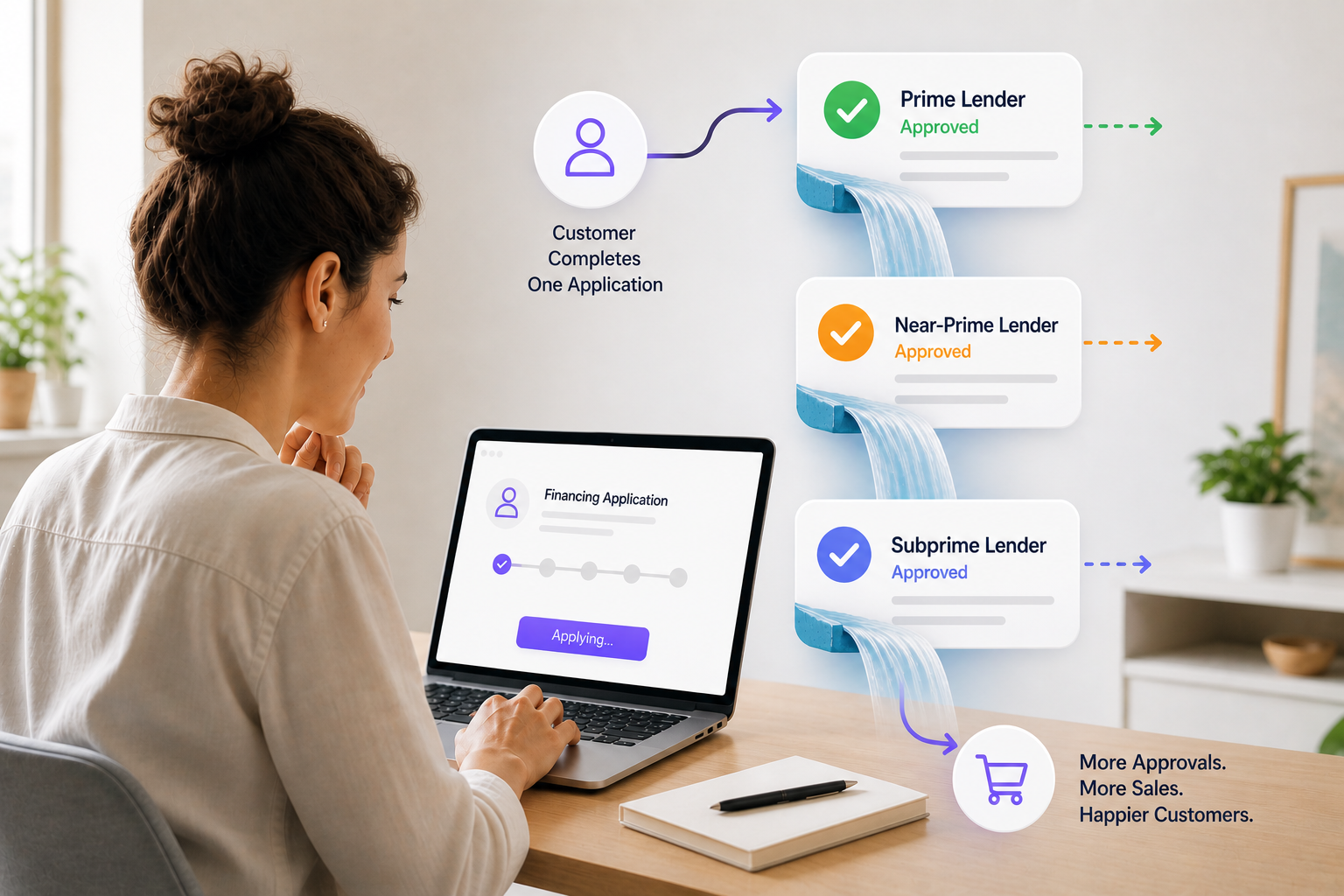
Waterfall financing involves a customer completing a short application for financing during their purchasing process and being automatically routed through a configuration of lenders. Starting with prime lenders and routing to near-prime and finally subprime options, waterfall financing maximizes approval rates by matching each customer to the most suitable financing options based on their profile, without requiring multiple applications and without impacting their credit score.
Here’s how waterfall financing works behind the scenes:
- Your customer completes a short application, wherever they are (for example in-store, online, or at home)
- The platform instantly checks for approval with a prime lender, helping prime customers secure the best terms.
- If declined, it automatically moves to near-prime options, for the next best offers.
- A shopper with challenged or limited credit history who has been declined by near-prime options, will be instantly referred to a tertiary option.
All of this happens in real time, creating a fast and seamless experience.
Waterfall financing is particularly impactful in industries selling high-ticket items, where affordability can be a barrier to purchase, such as:
- Home improvement
- Furniture & high-ticket retail
- Automotive aftermarket
- Fitness equipment

Why single-lender financing limits your growth
Relying on one, or even a few disconnected lenders, can limit approvals and create friction. When each lender operates independently, shoppers often face inconsistent decisions, multiple applications, while merchants contend with multiple complex systems and limited visibility into performance. The result is missed conversions and a less than ideal customer journey.
Here’s the reality many merchants face:
| Challenge | Impact |
| Multiple lenders operating independently | Inconsistent approvals and gaps in coverage |
| Separate or repeated applications | Friction and customer drop-off |
| Limited visibility or control | Missed optimization opportunities |
| Gaps across credit tiers | Lost conversions and revenue |
| Disjointed experience | Lower customer satisfaction and NPS |
In industries like home improvement and home services, these challenges are often amplified as the financing process usually takes place directly in the customer’s home and are often related to urgent repairs or essential upgrades. As a result:
- Customer postpones or downsizes project, or even seeks a cheaper, less reliable alternative
- Contractor loses the job, or closes a significantly smaller project
- Cash flow becomes unpredictable
This isn’t just about offering financing. It’s about how that financing is structured, managed, and experienced.
How waterfall financing boosts approvals and conversions
By dynamically routing shoppers across credit tiers, waterfall financing reduces unnecessary declines and keeps more customers moving forward, resulting in higher approvals, stronger conversion without disrupting the buying experience.
Here’s what changes
- Fewer dead ends in the approval journey
Customers move through a structured path to approval, reducing drop-off after an initial decline. - More choices all credit tiers
Applications aren’t forced into a one-size-fits-all model. Each customer is matched with the most suitable financing choices, ensuring customers receive the best possible terms for their credit score. - More confident purchasing behavior
When financing is accessible, transparent and reliable, customers are more likely to complete, and even expand, their purchase.
RBC Capital Markets data indicates that POS financing increases retail conversion rates by 20% to 30%, and increases average ticket size between 30% and 50%. Source

The hidden challenge: managing multiple lenders
While working with multiple lenders can expand approvals, it also introduces operational complexity. Multiple integrations, inconsistent experiences, and limited visibility make financing harder to manage and optimize. Without a unified approach, what ought to drive growth can instead create friction, for both customers and internal teams, including:
- Separate integrations and ongoing maintenance
- Different APIs and approval logic
- Fragmented reporting across providers
- Inconsistent customer experiences at checkout
- Complex post-sale workflows
And internally:
- Operations teams spend more time managing point-of-sale financing
- IT teams are pulled into maintaining and updating integrations
- Marketing teams have limited visibility and control over conversion performance
What to look for in a waterfall financing platform
A strong point-of-sale financing platform should unify multiple lenders into a single, seamless experience while intelligently optimizing how applications are routed across credit tiers. It should give merchants control over lender strategy, maintain neutrality, and deliver across channels so financing becomes easier to manage, optimize, and grow without adding complexity.
Here’s your checklist:
Single integration, multiple lenders
Simplifies operations by connecting to a broad lender network through one platform
Real-time routing optimization
Intelligently matches applications across prime, near-prime, and subprime lenders to maximize approvals
Neutral, platform-based approach
Ensures lender selection and routing decisions are driven by performance, not bias
Omnichannel support
Delivers a consistent experience across online, in-store, and assisted sales environments
Built-in conversion optimization
Provides visibility and control to test, adjust, and improve financing performance over time
Post-sale lifecycle management
Streamlines servicing, support, and communication after the transaction is complete
What to watch out for:
- Lender-owned platforms
May prioritize their own products, limiting flexibility and optimization - Limited lender ecosystems
Restrict coverage across the full credit spectrum - Inconsistent customer experiences
Especially across different credit tiers or channels
How ChargeAfter solves this
ChargeAfter enables merchants to bring multiple lenders together into a single, seamless financing experience. By optimizing how applications are routed across credit tiers, it helps increase approvals, simplify operations, and give merchants greater control, so customers instantly receive the right financing options without any friction or complexity.
ChargeAfter was built to address the core challenges merchants face today:
- Limited approvals across the full credit spectrum
- Operational complexity from managing multiple lenders
- Fragmented and inconsistent customer journeys
And replace this with a single platform to manage the entire financing process:
- One integration → multiple lenders
Simplifies connectivity while expanding financing coverage - Intelligent waterfall routing
Matches each application across prime, near-prime, and subprime lenders in real time - Fully embedded, omnichannel experience
Delivers a consistent journey across online, in-store, and assisted sales - Control and optimization tools
Gives merchants visibility into performance and the ability to refine their financing strategy - Support and scale
ChargeAfter is not just a platform, it is a strategic partner that will support you as you optimize, grow, and scale your financing program. - With ChargeAfter the focus is on: Neutrality, flexibility and conversion optimization at scale
Key takeaways
- Expanding beyond a single lender model is key to increasing approvals and capturing more revenue
- Waterfall financing boosts conversion by matching customers across the full credit spectrum with the most suitable options
- Multi-lender strategies are powerful, but require orchestration for simplicity and efficiency
- The right platform simplifies operations while giving merchants greater control and visibility
- Seamless customer experiences are just as critical as approval rates in driving long-term loyalty
Final thoughts
If financing drives your revenue, then approvals drive your growth. Waterfall financing isn’t just a feature, it’s a competitive advantage when it’s implemented in a way that’s seamless, scalable, and built for control.
If you want to learn more, you can watch this episode from our POS Finance Innovators series, where we speak with Rolando De Gracia from Concora Credit about the critical role of multiple financing options at the point of sale.
FAQs
Waterfall financing routes applications across multiple lenders, typically spanning prime, near-prime, and subprime tiers, so each customer is matched with the most suitable financing option. This significantly increases the likelihood of approval and customer satisfaction.
Yes. Instead of requiring customers to apply multiple times, waterfall financing uses a single application and routes it automatically, reducing friction, speeding up decisions, and improving conversion rates.
Yes, when implemented correctly. Because everything happens in real time and behind the scenes, customers benefit from a faster, simpler process with a higher chance of approval and no need to reapply.
Industries with high average order values see the greatest impact, such as home improvement, furniture and retail, automotive aftermarket, and fitness equipment, where financing often plays a key role in completing the purchase.