
BNPL vs. Consumer Financing: What Are the Key Differences?

Since entering the mainstream in the early 2020s, Buy Now, Pay Later (BNPL) has become the most recognizable form of consumer financing. However, BNPL is only one component of a much broader ecosystem: Point of Sale (POS) financing.
While these terms are often used interchangeably, they are not the same. In reality, BNPL is simply one specialized tool within the larger POS financing toolkit.
In this article, we’ll explain how the two differ, where they overlap, and why offering multiple financing options at checkout is key to increasing approvals, improving conversion rates, and delivering a better customer experience.
What you’ll learn
- What BNPL is and how it works
- The difference between BNPL and POS financing
- Which other POS financing products are available
- How offering multiple financing options can increase approvals and conversions
- What to look for in a POS financing platform
What Is Buy Now, Pay Later (BNPL)?
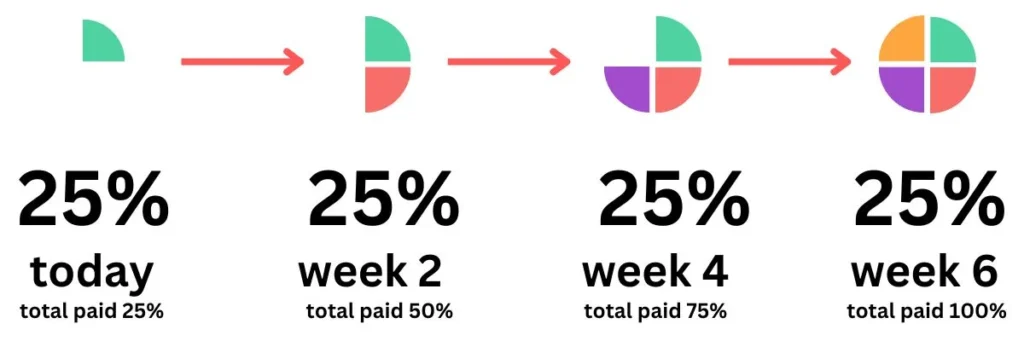
Buy Now, Pay Later (BNPL) is a short-term financing solution that allows consumers to make a purchase and spread the cost over a series of interest-free installments, usually repaid over four to six weeks.
There are certain characteristics that define BNPL. They include:
The “Pay in 4” model: The most common variation of BNPL splits a total purchase into four equal payments. The first 25% is due immediately, while the remaining three installments are billed, over a period of four or six weeks. Loan amounts usually run between $50 to $1,000.
The soft credit check: Most BNPL providers use a soft credit check for Pay in 4 purchases that does not affect the consumer’s credit score.
Zero interest (usually): Most Pay in 4 BNPL products are interest-free when payments are made on time. Some providers also offer longer-term installment loans, which may charge interest depending on the terms.
Merchant settlement: While the customer repays the purchase over time, the merchant typically receives payment upfront (less the provider’s transaction fee). The BNPL provider assumes responsibility for collecting repayments and managing credit risk.
Which other POS financing options are available?
Point-of-sale (POS) financing is an umbrella term for any consumer or business credit solution integrated directly into a merchant’s checkout flow. While BNPL is a highly recognizable subset, POS financing encompasses a broad suite of credit, loan, and lease products designed to accommodate different customer risk profiles, industry verticals, and purchase sizes.
To capture the full spectrum of buyer demographics and transaction values, merchants utilize diverse POS financing options:
0% APR Financing (Promotional Financing)
What it is:
Allows customers to spread the cost of a purchase over 6–24 months without paying interest.
Ideal customer:
Prime and super-prime consumers with strong credit histories.
Best for:
High-ticket retail purchases such as furniture, appliances, electronics, and jewelry.
Installment Loans
What it is:
A fixed-term loan repaid in monthly installments, typically over 6–60 months.
Ideal customer:
Prime, near-prime, and some non-prime consumers, depending on the lender.
Best for:
Home improvement, healthcare, automotive repairs, and other larger purchases.
Revolving Credit
What it is: An open-ended line of credit, such as a store-branded credit card, that can be used repeatedly up to a set limit.
Ideal customer: Prime and near-prime customers who are likely to make repeat purchases.
Best for: Routine lifestyle costs and ongoing everyday expenses like groceries, gas, and subscriptions.
Lease-to-Own (LTO)
What it is: A rental-purchase agreement that allows consumers to acquire ownership of a product over a set term.
Ideal customer: Customers who may not qualify for traditional credit or prefer a no-credit-required financing option.
Best for: Durable physical consumer goods with resale value, such as furniture, large appliances, and tires.
Business Financing (B2B BNPL)
What it is: A business-to-business credit option that provides flexible payment terms to corporate buyers.
Ideal customer: Businesses seeking greater cash flow flexibility and extended payment terms.
Best for: Corporate expenses, inventory procurement, raw materials, and software licensing.

How BNPL compares to a comprehensive POS financing strategy
BNPL is one financing product while POS financing can incorporate multiple financing options.
The table below highlights the key differences:
| BNPL | POS Financing |
|---|---|
| A single financing product | A category of financing offered at checkout |
| Typically short-term installments | Multiple financing products |
| Usually one provider | One or multiple lenders |
| Best suited to specific purchase types | Supports a wide range of purchase values |
| Covers certain customer segments | Can serve a broader range of credit profiles |
The challenge of disconnected lender relationships
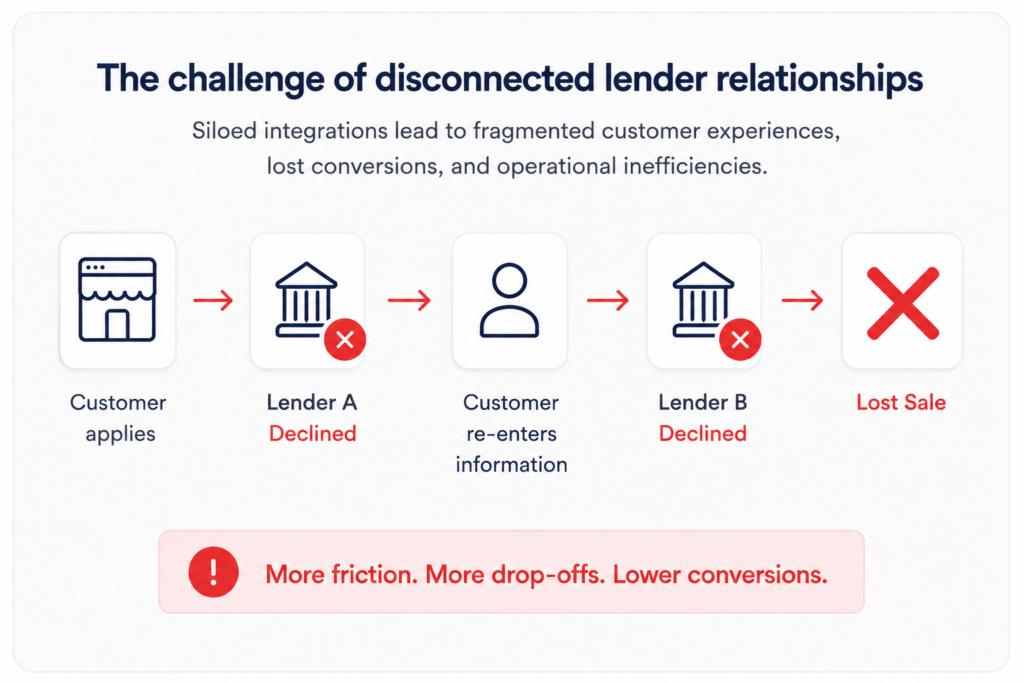
Many merchants have expanded beyond a single financing provider. While this increases financing choice, it often results in disconnected lender relationships, with separate integrations, customer journeys, reporting tools, and operational processes.
Offering multiple financing options is a step in the right direction, however managing disconnected lender relationships can introduce operational complexity and checkout friction. Such challenges include.
- The repeat application problem
If a shopper applies for financing through Lender A (e.g., a 0% APR promo loan) and is declined, they are either met with a dead end. or the option to try a second option (Lender B). To apply to lender B the customer must complete a separate application, and still may be declined. This high-friction experience can damage customer trust and lead to cart abandonment. - A cluttered checkout page
When financing providers are integrated independently, each typically requires its own promotional messaging, application flow, and checkout placement. Instead of presenting a unified financing experience, merchants often end up with multiple widgets, banners, and calls to action competing for attention. - No automatic “waterfall” flow
Without a centralized platform, application data is typically not passed automatically between lenders. This makes it difficult to automatically cascade a customer’s declined application to a secondary lender and the merchant can miss an opportunity to salvage the sale. - Duplicate operational overhead
Managing disconnected lender relationships duplicates work across your entire business. Development teams must maintain completely separate API integrations, accounting teams must reconcile disjointed settlement files across different portals, and support agents must learn multiple workflows. - Limited program flexibility
As business needs change, merchants often want to introduce new financing products, replace lenders, or enter new markets. With disconnected lender relationships, every change can require additional integrations, testing, and operational effort, making it difficult to evolve the financing program over time.
These challenges aren’t caused by offering multiple lenders, rather they are caused by managing them independently.
What to look for in a POS financing platform
To solve the challenges of disconnected lender networks, many merchants are shifting toward centralized POS financing platforms. However, not all platforms are created equally. To ensure you choose a platform that scales with your business and maximizes your sales, look for these five critical capabilities.
-
Straightforward implementation through a single integration
Instead of building, testing, and maintaining separate integrations for every lender, a POS financing platform should provide a single, unified integration that connects merchants to multiple lenders and financing products. Look for a platform that offers:
- Fast implementation: Pre-built ecommerce plugins, standardized APIs, client-side SDKs, and developer tools help merchants deploy complete financing programs in weeks rather than months.
- Simplified maintenance: As lenders update APIs, underwriting criteria, or promotional programs, the platform manages these changes centrally, reducing the maintenance burden on internal teams.
- Built-in security and compliance: Enterprise-grade platforms incorporate advanced security controls, data encryption, and support for standards such as PCI DSS and ISO certifications, helping simplify implementation while reducing operational risk.
-
Deliver a unified omnichannel customer experience
Customers expect a consistent financing experience regardless of how they choose to shop. A POS financing platform should provide a frictionless journey across ecommerce, in-store, in-home, telesales, and mobile channels. Look for a platform that offers:
- One application across every channel: Customers enter their information once, regardless of where they begin their purchase journey.
- Multiple financing offers through a single experience: The platform evaluates applications across the available lender network to identify eligible financing options without requiring customers to complete multiple applications.
- A white-label customer journey: Financing should feel like a natural extension of your brand, with a consistent look and feel from application through approval.
-
Maximize customer choice with an independent lender network
No single lender can meet the needs of every customer. A broad, independent lender network helps merchants serve a wider range of purchase values, financing preferences, and credit profiles. Look for a platform that offers:
- Full credit spectrum coverage: Access to prime, near-prime, subprime, lease-to-own, BNPL, and business financing providers.
- Platform independence: An independent platform remains lender-agnostic, allowing financing decisions to be based on customer needs rather than a single provider’s priorities.
- Greater resilience: Merchants can add, replace, or rebalance lenders as market conditions or business requirements change without disrupting the customer experience.
-
Increase approvals with intelligent application routing
A financing platform should do more than connect to multiple lenders—it should intelligently match customers with the best-fit options. Look for a platform that offers:
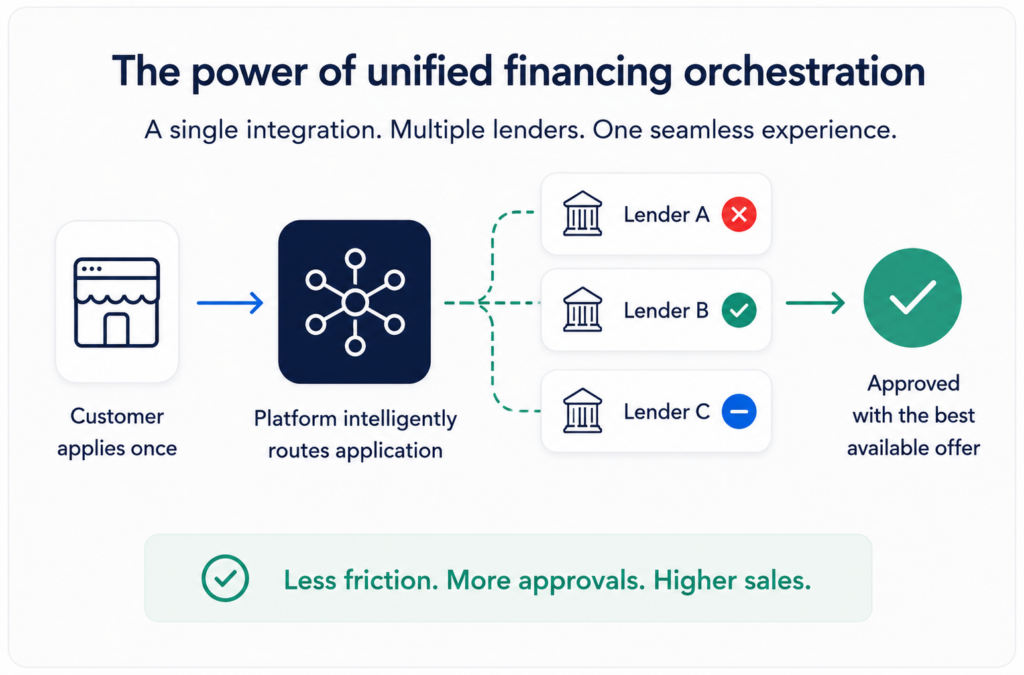
- Automated waterfall financing: Declined applications are routed automatically to additional eligible lenders without requiring customers to reapply.
- Intelligent matching: Routing logic evaluates customer and transaction characteristics to identify the most appropriate financing option.
- Fast, frictionless decisions: The entire process takes place behind the scenes in seconds, minimizing checkout friction while helping maximize approvals.
-
Simplify operations with centralized program management
Managing multiple financing providers shouldn’t require multiple systems. A modern platform should centralize reporting, settlements, customer support, and program analytics into a single operational hub. Look for a platform that offers:
- Centralized reconciliation and settlements: Finance teams can manage transactions, settlements, fees, and refunds across every financing provider from one dashboard.
- Unified customer support: Customer service representatives have one portal to access transaction histories, manage disputes, and process refunds.
- Comprehensive performance analytics: Unified reporting across approval rates, conversion rates, average order value, lender performance, and financing mix helps merchants continuously optimize their financing strategy.
Key takeaways
- BNPL is only one type of consumer financing. While it has become one of the most recognized financing options, it represents just one component of a broader POS financing strategy.
- Different customers need different financing options. Offering a mix of BNPL, promotional financing, installment loans, revolving credit, lease-to-own, and business financing helps merchants serve a wider range of purchase amounts, customer preferences, and credit profiles.
- Disconnected lender relationships create unnecessary friction. Managing multiple lenders independently can lead to duplicate integrations, inconsistent customer experiences, repeat applications, and operational complexity that impacts conversion and efficiency.
- POS financing platforms unify the entire financing ecosystem. A single integration, intelligent application routing, centralized reporting, and a consistent customer experience simplify operations while helping merchants maximize approvals.
- The best financing strategy is built for flexibility. As customer needs, financing products, and lender networks evolve, merchants benefit from platforms that make it easy to add lenders, introduce new financing options, and optimize performance without rebuilding their checkout experience.
Conclusion
Merchants increasingly need financing programs that can support a broader range of purchase amounts, credit profiles, and financing preferences.
Rather than relying on a single lender or financing product, leading merchants are adopting flexible POS financing strategies that bring together multiple lenders, financing options, and intelligent application routing through a single platform. This approach not only helps increase approvals and improve conversions, but also simplifies operations and gives merchants the flexibility to adapt as their business grows.
ChargeAfter helps leading enterprise merchants do exactly that. Through a single integration, merchants can access the largest independent network of lenders and financing products, intelligently route applications, and deliver a seamless financing experience across every sales channel.
To learn more, book a demo or connect with me directly to discuss how ChargeAfter can help optimize your financing program.
Frequently asked questions
No. BNPL is one type of consumer financing. Consumer financing is a broader category that includes BNPL, promotional financing, installment loans, revolving credit, lease-to-own, and other financing products.
BNPL is a specific financing product that allows consumers to spread payments over time, often through interest-free installments. POS financing is the broader strategy of offering financing at checkout and can include multiple financing products and lenders.
Modern POS financing programs can include Buy Now, Pay Later (BNPL), promotional financing (0% APR), installment loans, revolving credit, lease-to-own, and business financing. The right mix depends on the merchant’s industry, average order value, and customer base.
Different lenders serve different customer credit profiles, purchase sizes, and financing needs. Offering multiple lenders can increase approval rates, provide customers with more financing choices, and reduce dependence on any single financing provider.
Lender orchestration is the process of connecting multiple lenders through a single platform and intelligently routing applications to the financing option most likely to result in an approval. It simplifies financing program management while improving the customer experience.
Merchants should look for a platform that offers a single integration, access to multiple financing products and lenders, intelligent application routing, a consistent omnichannel customer experience, centralized reporting, and the flexibility to add or replace lenders as business needs evolve.
It depends on the platform. Traditional lender integrations often require additional development work when adding or replacing financing providers. Modern orchestration platforms enable merchants to expand or modify their lender network with significantly less implementation effort while maintaining a consistent customer experience.
